






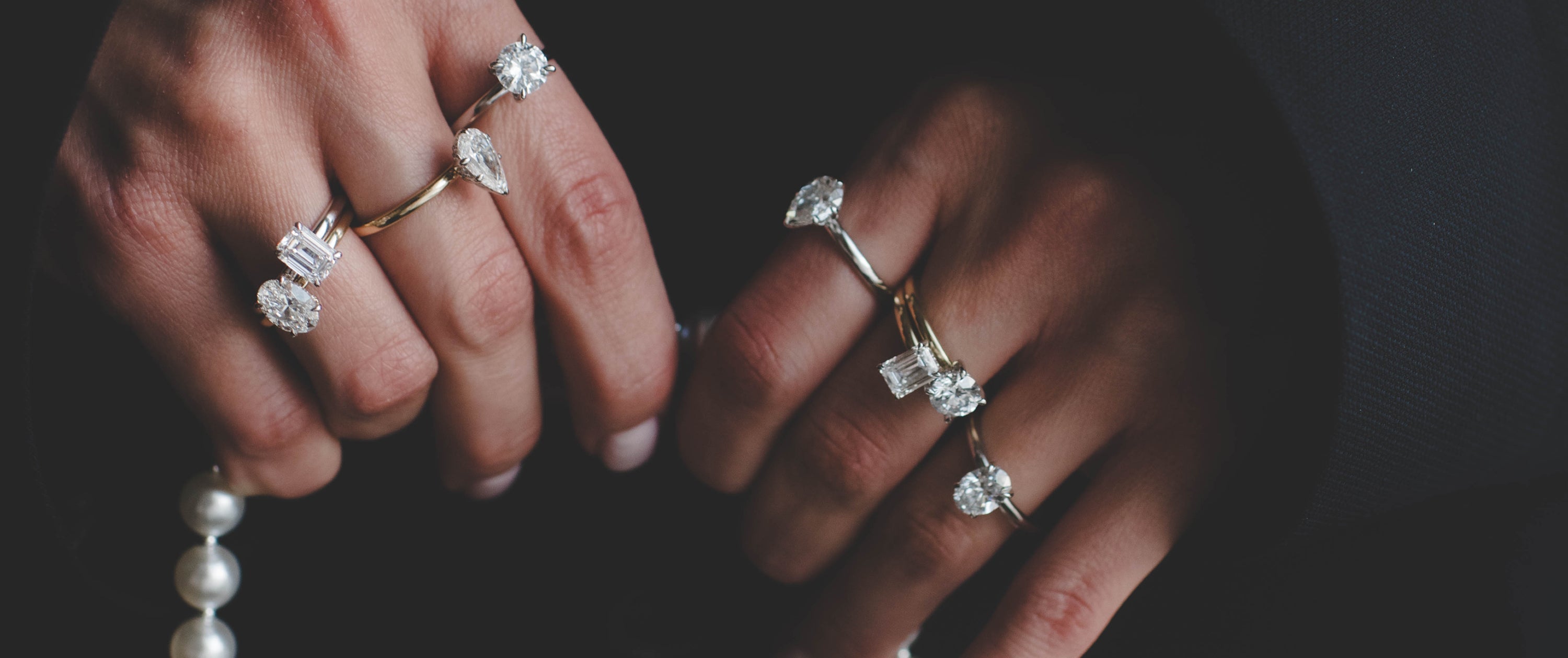
Colour and Clarity of Diamonds
If you're starting to look for the perfect engagement ring, you might have come across the 4C's of Diamonds. Understanding those will help your journey to find the ring made for you.
Diamond Colour
Choosing the colour of your diamond solely depends on your preference. The colour scale starts from Very-Light-Coloured diamonds to Colourless diamonds. The grade colour scale determines the colour of the diamonds based on the visibility of a yellow/brown tint on the diamond.
Colourless Diamonds
- D
- E
- F
Colourless diamonds are considered to be white diamonds. You cannot visibly see any tinting of the diamond. It is advised to match colourless diamonds with white gold or platinum to elevate the colourless effect.
Near Colourless Diamonds
- G
- H
- I
- J
Near colourless diamonds do, in fact, contain traces of colour; however, they do look colourless if paired with white gold/platinum metals. G-J diamonds are more affordable than D-F diamonds since they are usually retailed at a lower price.
Faint Colour Diamonds
- K
- L
- M
Faint colour diamonds have a yellow taint that the naked eye can easily detect. It is advised to pair K-M diamonds with yellow gold instead of white gold/platinum. The warm colour of the diamond will match the yellow tones of the ring, making the stone more appealing to some.
Diamond Clarity
Since diamonds are formed under the earth and subjected to extremely high temperatures and pressures, they tend to contain minor imperfections. If the imperfections are on the outside of the diamonds, they are called blemishes. If the imperfections are on the inside of the diamonds, they are called inclusions. The degree of visibility of these imperfections determines the clarity of the diamond.
Diamond Clarity Scale
-
Flawless (FL):
Flawless diamonds have zero inclusions or blemishes visible using a 10x magnifier. (Less than 1 in 5000 diamonds are rated FL) -
Internally Flawless (IF):
No inclusions are visible using a 10x magnifier; only a few blemishes can be seen. (Less than 3% diamonds are rated IF) -
Very, Very Slightly Included (VVS1-VVS2):
The inclusions on VVS1-VVS2 diamonds are visible but difficult to see using a 10x magnifier. (VVS1-VVS2 diamonds appear identical to IF/FL diamonds to the naked eye) -
Very Slightly Included (VS1-VS2):
Inclusions are clearly visible using a 10x magnifier; however, they are not significant inclusions. (The naked eye can possibly detect VS2 inclusions upon close inspection under certain conditions) -
Slightly Included (SI1-S12):
The inclusions are easily noticeable using a 10x magnifier. (The naked eye may see the inclusions under close inspection) -
Included (I1-I3):
Inclusions are very obvious using a 10x magnifier and are almost always visible to the naked eye. It is advised to avoid I1-I3 diamonds since the inclusions may affect the diamond’s durability.

Explore Our Collections
Now that you are prepared to make an informed decision about your dream ring, it’s time to choose from our vast collection of engagement rings. Contact the team if you have any further questions, or visit a store near you! We look forward to making your dreams come true.
Read more

How to maintain that beautiful sparkle and shine that makes diamond pieces so captivating.
Read more
The Benefits of 2 Carat Engagement Rings
From an eye-catching appeal, to better value, and more setting options.
Read more